
Overview
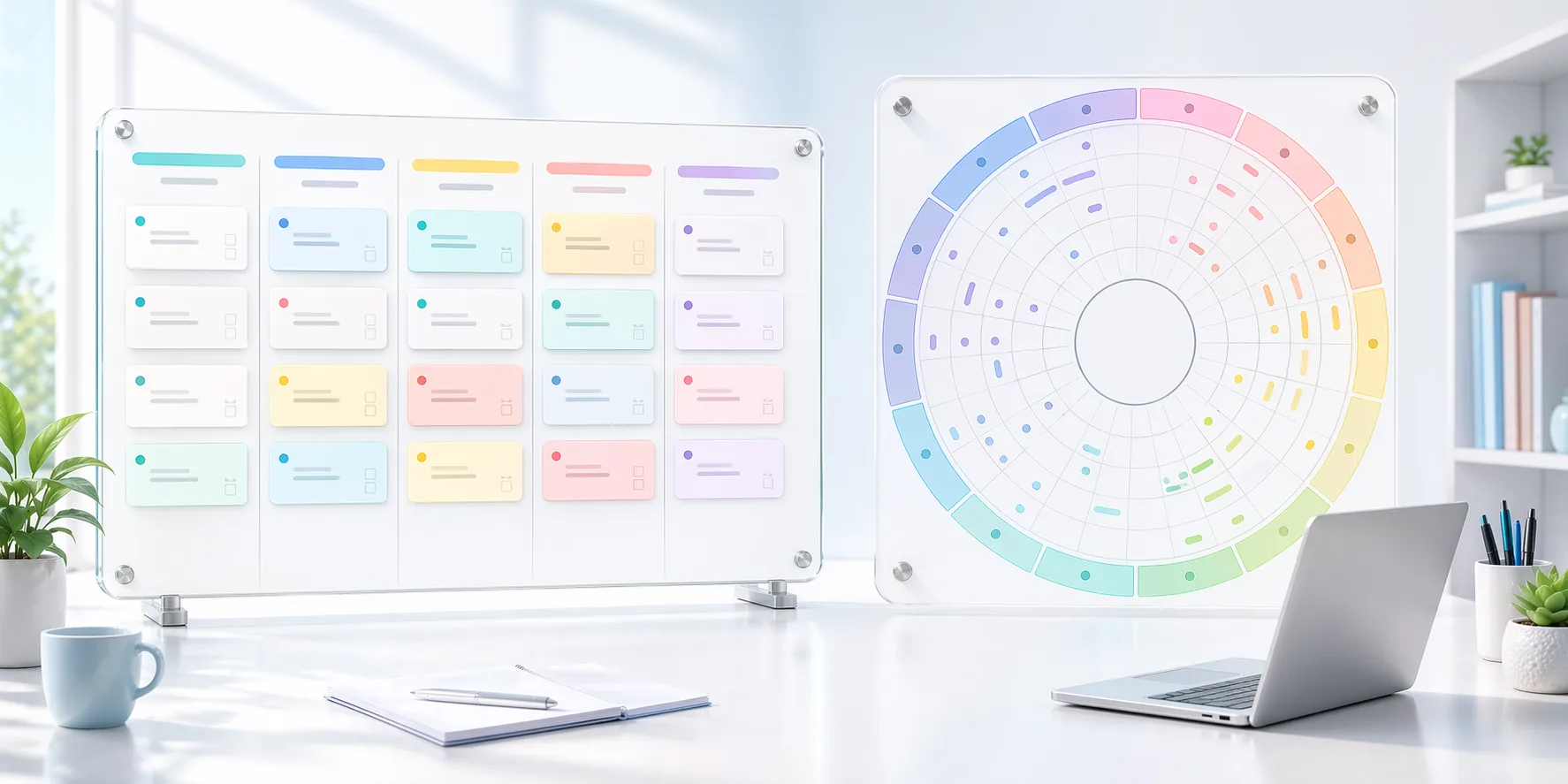
Teams often choose a planning tool because it looks familiar, not because it matches the shape of the work. A Kanban board is excellent for ongoing execution, while a year wheel is better for recurring cycles, campaigns, and seasonal planning. Problems start when one model is forced to do the other model’s job.
The right choice depends on whether the team is managing flow through stages or coordinating work across months, seasons, and repeating annual moments.
Practical planning-model notes
Kanban and year-wheel planning solve different visibility problems. Kanban is good at showing flow and ownership. A year wheel is good at showing seasonality, launch windows, and the distance between important moments.
Choosing the wrong view makes the work feel harder than it is. A launch calendar forced into Kanban can lose timing context, while a live task list forced into a year wheel can hide blockers and handoffs.
Many teams need both views, but not for the same level of detail. Keep the year wheel high-level enough to reveal timing patterns, and keep Kanban focused enough to show what is actually moving this week.
Choose the right view
- Use Kanban when ownership, status, and blockers matter most.
- Use the year wheel when timing, seasonality, and spacing matter most.
- Avoid duplicating every task into both views.
- Review the connection between the two views on a predictable rhythm.
Who this is for
- Teams managing active delivery, campaigns, and recurring programs.
- Operators who plan annual rhythms but still need near-term execution clarity.
- People deciding how to split strategy planning from day-to-day work.
Step-by-step guidance
Step 1
Use Kanban when the key question is “what stage is this in?”
Kanban is strongest when work moves through clear states such as backlog, in progress, review, and done. It gives teams immediate visibility into load, blockers, and ownership. If your work is active, changing, and status-heavy, Kanban is usually the better operating view.
Step 2
Use a year wheel when the key question is “when in the year does this need to happen?”
Year wheels are better for annual programs, launch seasons, campaign windows, educational cycles, recurring promotions, and long-range coordination. They reveal spacing, overlap, and timing in a way that lane boards do not.
Step 3
Do not use one view to answer two different planning questions
If your team needs both execution status and long-range rhythm, it is usually better to keep both models rather than stretching one beyond its strengths. A year wheel can frame the year. A Kanban board can run the active work inside that frame.
Step 4
Choose the primary view based on what decisions happen most often
If the team mostly decides priorities, progress, and blockers, Kanban should lead. If the team mostly decides timing, sequencing through the year, and campaign spacing, the year wheel should lead.
A combined planning setup
A marketing team might keep quarterly campaigns on the year wheel, then pull only the next active campaign into Kanban. That keeps the annual picture visible without flooding the task board with work that is not ready yet.
During weekly planning, the team checks the wheel for upcoming timing pressure and uses Kanban to decide what moves next. Each view answers its own question, which keeps planning calmer.
Comparison or example section
Kanban clarifies movement through work. A year wheel clarifies position in time. One is operationally vertical through stages, while the other is strategically horizontal through the calendar. Many teams need both, but they should not confuse their purposes.
Mistakes to avoid
- Trying to visualize annual seasonality inside a simple lane board.
- Tracking daily task progress inside a year wheel.
- Choosing one model because it is familiar instead of because it answers the main planning question.
- Assuming a long-range planning view can replace an execution board.
Planning help
Use the planning view that matches what you are doing
Planner works best when active work and longer-range timing are treated as two different jobs instead of being forced into one board.
Best for
- Teams managing ongoing execution in stages.
- Operators who need to plan annual campaigns or recurring programs.
- People who want a cleaner split between strategy timing and current workload.
How to use it well
Use lanes for work that is moving now: Choose the lane-based view when the important questions are what is next, what is blocked, and who owns the active work.
Use the year wheel for timing: Choose the year wheel when spacing, seasonality, launches, and recurring cycles matter more than day-to-day status updates.
Let the two views do different jobs: The year wheel gives you the bigger timing picture, while the lane planner handles the work that is actually in motion this week.
Keep weekly planning tied to the bigger plan: A simple rhythm works best: check the year view when you need timing context, then use the weekly board to run the work that is currently live.
FAQ
Can one team use both a year wheel and Kanban?
Yes. Many teams benefit from a year wheel for high-level timing and a Kanban board for the active work that makes those plans real.
Which is better for campaigns and seasonal launches?
A year wheel is usually better for planning campaigns across the year because it makes timing and spacing easier to understand.
Which is better for weekly delivery management?
Kanban is better for weekly execution because it shows what is queued, active, blocked, and complete.